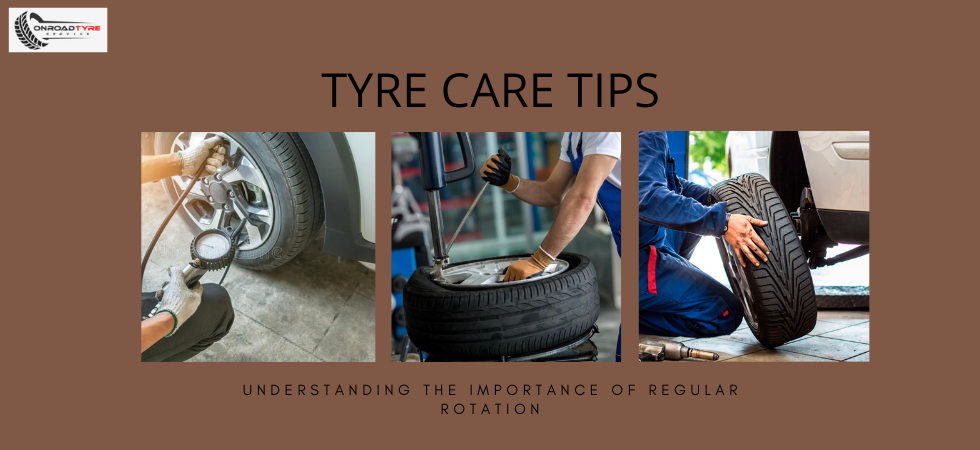
Tyre Care Tips: Understanding the Importance of Regular Rotation
Your tyres are the things that do more for your vehicle than just rolling — they are the lifeblood of your safety, fuel saving and general driving comfort. However, a large number of car and truck owners fail to take one easy maintenance step that can significantly extend tyre life: regular rotation, seriously.
In case you have been asking for tyre repairs near me or have been wondering why tyres wear unevenly then this guide will be your informer. At OnRoad Tyre Service, we are expert in mobile tyre solutions, from tyre replacement near me to mobile tyre repair, and we understand the key role of tyre rotation in a safe and cost-effective driving.
What is Tyre Rotation?
Tyre rotation refers to the procedure of taking the tyres from one position on a vehicle and placing them at another, normally every 8,000–10,000 km. The idea is to have the same amount of wear in all four tyres as no one should be subjected to the same amount of stress.
- Front tyres get worn out more quickly as they are doing the steering and most of the braking work.
- Rear tyres are likely to wear as evenly as possible but still can have different wear patterns depending on the weight and suspension of the car.
- By rotating tyres regularly you ensure that both sides of the tyres are getting worn in a balanced manner and hence you will get the full set of tyres to last longer.
Why Tyre Rotation Matters
Even Tread Wear
Should you not rotate your front tyres may wear twice as fast than the rear ones. Having the same tread depth in all tyres leads to better traction and safer handling.
Improved Safety
Uneven tyres make the braking less efficient, increase the likelihood of skidding, and turn driving into a less predictable activity in the case of wet conditions. Rotation improves stability and control.
Cost Savings
If done regularly rotation will push the replacement of tyres further thus making you save more money. Instead of doing two tyres at a time you may go for replacement of a full set less frequently.
Better Fuel Efficiency
Tyres that are evenly worn are rolling more smoothly and hence fuel consumption will be lower. On the other hand, uneven tyres create resistance and thus your engine has to work harder.
Preserves Suspension & Steering Components
Uneven tyre wear will always require that the suspension and steering systems will absorb the excessive stress. Rotation distributes the work evenly, thus helping these parts to be around for a long time.
Signs You Need Tyre Rotation
- Only one or two tyres are significantly more worn than the others.
- While driving you can feel a vibration or the car is pulling to one side.
- The car you are driving loses stability during wet weather and you are not quite sure why.
- You have not done tyre rotation for more than 10,000 km.
If the situations mentioned above are what you are dealing with, then a mobile tyre replacement is the way to go along with the inquiry about tyre balancing at the next service.
Recommended Tyre Rotation Patterns
A specific rotation pattern that is of the most benefit to your vehicle depends on the type of vehicle and how the tyres are arranged.
- Front-Wheel Drive (FWD): The tyres that are on the front are swapped with the ones that are at the back in a crisscross pattern.
- Rear-Wheel Drive (RWD): While rear tyres move forward in a crisscross, front tyres are taken straight back.
- Four-Wheel Drive (4WD)/All-Wheel Drive (AWD): An "X-pattern" is used to even out the stress on all tyres.
- Directional Tyres: Those can only be rotated from front to back, not from side to side.
One of the most important things in tyre repairs near me or rotation is that the service is executed according to the manufacturers’ recommendations.
Tyre Rotation vs Tyre Alignment & Balancing
The drivers are often mistaken about the confusion of these services, however, they are different:
- Tyre rotation: changing the positions of the tyres to ensure the wear is even.
- Tyre balancing: the process of bringing the distribution of the weight to a point where the tyres are rolling smoothly.
- Wheel alignment: the fixing of the angles so that the tyres can make proper contact with the road.
The best effects are usually achieved when rotation is done together with balancing and alignment checks.
How Often Should You Rotate Your Tyres?
- Every 8,000–10,000 km (or roughly every 6 months).
- A condition where you would need to rotate your tyres more often is when you drive in harsh conditions, carry heavy loads, or do long-haul driving.
- Try to be specific and rely on your owner’s manual for the manufacturer's recommendations.
Final Thoughts
One of the most common mistakes made by drivers is not performing tyre rotation. Regularly rotating your tyres:
- Extends tyre lifespan
- Increases the safety of the driver
- Helps to save fuel
- Lowers long-term repair costs
At OnRoad Tyre Service, we offer the full spectrum of tyre care services such as mobile tyre repair, tyre puncture repair near me, and truck tyre repair near me. Don’t let it get to a point where your tyres are uneven to a dangerous extent, take the next rotation at the wheel of your vehicle.